EMT Practice Test

1. Question Content...


Question List

Question1: Exhibit:

Your customer is deploying SnapCenter to protect volumes on an ONTAP Select cluster.
Referring to the exhibit, which licensing is required to protect the Engineering and Marketing volumes?

Question2: You are asked to perform a NetApp Snapshot copy single-file restore on a corrupted thin-provisioned LUN that is 10 GB in size and is currently at 80% full.
How much additionalfree space do you need in the volume to perform this operation?

Question3: A customer wants to create a new SnapMirror relationship to provide only disaster recovery for their organization.
Which relationship type and policy type should they specify in this scenario?

Question4: Which two NetApp ONTAP cluster technologies only replicate the changes to WAFL blocks of a volume? (Choose two.)

Question5: You are asked to verify that data stored in your disaster recovery site can be restored and is viable. Currently, you have a NetApp SnapMirror relationship with a MirrorAllSnaps policy type that is enabled and is updating frequently.
What would be a nondisruptive method to carry out a detailed validation of your disaster-recovery strategy?

Question6: What is MetroCluster in NetApp ONTAP?

Question7: You have just deployed a new AFF A400 cluster running ONTAP 9.7 that currently has no data aggregates created. You want to ensure that all new data aggregates are encrypted before you migrate production data to the new AFF A400 cluster.
In this scenario, which two actions would you use to accomplish this task? (Choose two.)

Question8: You are asked to create application-consistent Snapshot copies of VM guests that are running in your VMware environment that have datastores from an ONTAP 9.8 AFF cluster.
What is required to accomplish this task?

Question9: What is a cloud tiering policy in NetApp ONTAP?

Question10: You have a NAS volume that contains 250 GB of data with a daily change rate of 10%. You want to keep seven daily Snapshot copies.
In this scenario, what should the minimum copies of the volume be?

Question11: Which ONTAP feature allows the customer to deploy applications with SnapShot protection on the AFF nodes?

Question12: Exhibit:

Referring to the exhibit, which volume has the highest level of protection assigned to it?

Question13: The company you work for is using SnapMirror to replicate data from their on-premises primary ONTAP cluster to an instance of Cloud Volumes ONTAP in Google Cloud.
You are asked to use the ONTAP REST APIs to automate the process that allows the destination to be writable in the event of losing the primary site.
Which step is required to achieve this task?

Question14: Your customer wants to implement a mirroring solution between two NetApp controllers.
Which solution would you recommend tothe customer?

Question15: You must back up and replicate a Microsoft SQL server using SnapProtect in your clustered Data ONTAP environment.
Which three components must be correctly installed and configured? (Choose three.)

Question16: What is RAID-DP in NetApp ONTAP?

Question17: You notice that after you delete data from your FlexVol volume, some Snapshot copies have also been deleted. Snapshot auto delete is enabled.
Which volume autosize mode must be enabled for this behavior to occur?

Question18: How can you ensure regulatory compliance in a data protection solution?

Question19: What are the key factors to consider when designing a data protection solution?

Question20: A customer has a MetroCluster configuration and wants to automate the disaster recovery process for unplanned automatic switchover.
Which NetApp tool would accomplish this task?

Question21: You are running a NetApp AFF A220 cluster. Each node has one volume. You create Snapshot copies on both volumes every four hours and keep the copies for 30 days. You are running out of disk space and want to free up space.
In this scenario, what do you do?

Question22: A customer wants to maintain a single copy for both disaster recovery and backup on a secondary system.
Which SnapMirror policy andrelationship type should be used?

Question23: What is the purpose of a hybrid cloud data protection solution?

Question24: Your manager requires you to protect a production SVM called svm01 by using SVM-DR. Your manager insiststhat all configuration and data LUNs be replicated to the DR cluster. The destination SVM should be called drsvm01. You set up an SVM-DR relationship between the clusters, specifying that the - identity- preserve option is set to true.
After the initial replication completes, you discover that the iSCSI LIF configuration has not been replicated to drsvm01.
What should you do to solve this problem?

Question25: Click the Exhibit button on the right.

You have an AFF A300 controller with four volumes in the aggregate that is shown in the exhibit. You replicate all four volumes to one aggregate on a FAS8200 controller in a different cluster.
Referring to the exhibit, what are the storage efficiency savings on the destination FAS8200?

Question26: You have a network outage that affects client access to site You need to temporarily reverse the SnapMirror relationship of a volume to serve data from site B.
Which two steps must you perform first? (Choose two.)

Question27: Your customer wants to implement a solution to protect only a select number of NFSv3 volumes in a particular aggregate that stores their mission-critical application data. The customer wants the volume's data replicated to secondary storage and have application write operations fail if they cannot be replicated.
The customer needs to maintain a zero RPO and a very low RTO. In this scenario, which solution satisfies these requirements?

Question28: For DR purposes, data must be replicated between on-premises clusters and multiple public clouds.
In this scenario, which solution would simplify management?

Question29: You are administering your company's ONTAP SMB file services. You must perform a Snapshot copy every hour and replicate the Snapshot copy to a secondary ONTAP cluster.
Which two software products would you use to initialize the replication relationship? (Choose two.)

Question30: Exhibit:

You must set up SVM replication for the first time using CLI. This replication will be used for DR purposes. The SVM configuration does not need to be replicated at this time. In this configuration, you will be reusing a default policy.
Referring to the exhibit, what are two missing steps from the SVM replication workflow? (Choose two.)

Question31: Exhibit:

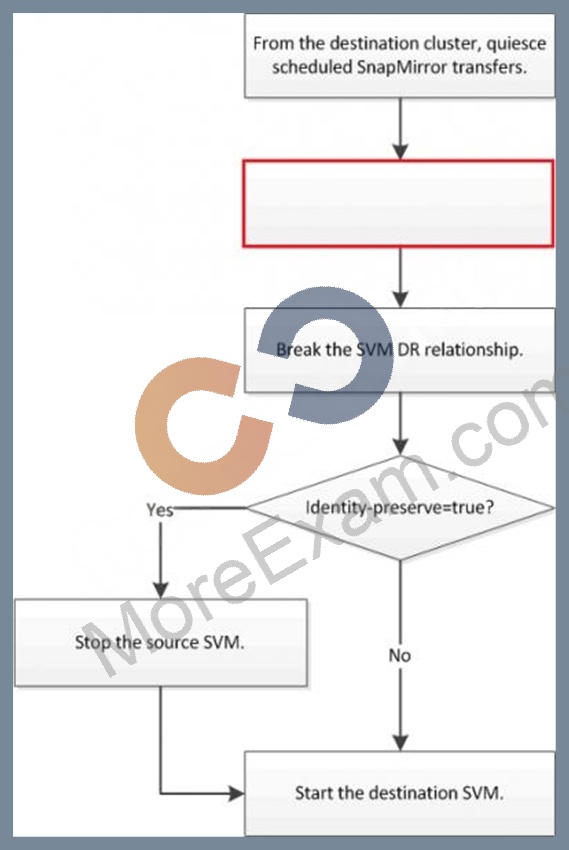
In an ONTAP environment, an SVM-DR relationship exists between your AFF A220 cluster and your FAS2720 cluster, with identity preserve enabled. You are asked to test the disaster recovery workflow in an upcoming maintenance window.
Referring to the exhibit, which step should be performed next to test the recovery workflow?

Question32: A previous administrator had configured an external backup system to use node-scoped NDMP for backups, but you want to change this system to use SVM-scoped NDMP.
How do you make this change in ONTAP?

Question33: You are asked to implement a DR solution to protect employee home directories on the primary cluster. The solution should provide an PRO of one hour, disaster recovery and archiving configured on the same destination volume of the DR cluster. Your solution should also reduce the amount of secondary storage requirements and use lower network traffic on the WAN links.
In this scenario, which NetApp replication technology satisfies these requirements?

Question34: Exhibit:

You have a volume that was configured a year ago using the default Snapshot policy that is shown in the exhibit. You need to increase the number of weekly maximum Snapshot copies to retain eight copies.
Which additional action is needed to have eight weekly Snapshot copies in this volume after modifying the schedule?

Question35: A customer wants a new solution that reaches a near-zero recovery time objective (RTO) and a zero recovery point objective (RPO).
In this scenario, which NetApp solution satisfies the requirements?

Question36: Click the Exhibit button.

You have a SnapProtect v11 environment as shown in the exhibit.
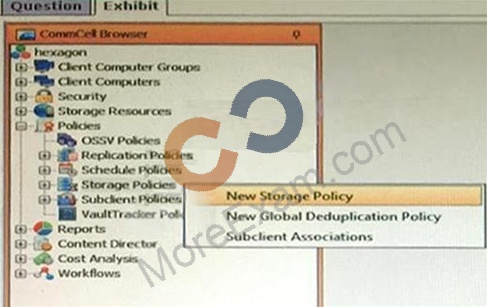
What are the two default Snapshot copies created automatically after creating a Storage Policy. (Choose two.)

Question37: You have deployed IntelliSnap to list NetApp Snapshot copies in volumes on your ONTAP system, schedule new backups on unprotected volumes, and implement archiving to your remote AltaVault system.
Which additional NetApp product does IntelliSnap require to perform all of these actions?

Question38: To ensure enough bandwidth for other applications, you want to restrict all replication bandwidth on your destination cluster.
How would you accomplish this task?

Question39: You want to write custom workflows to perform disaster recovery operations for your environment in OnCommand Workflow Automation.
In this scenario, which two scripting languages would be used to accomplish this task? (Choose two.)

Question40: You are the administrator of an ONTAP cluster, where the majority of users are using Linux machines with home directories mounted using NFS. You keep six daily, four weekly, and one monthly Snapshot copy locally. However, you do not replicate the data to another instance of ONTAP. One of your users reports having accidentally deleted a file, but does not remember the self-serve restore procedure.
How does the user restore the file without having administrator privileges on the cluster?

Question41: You have a SolidFire cluster running SolidFire Element Operating System 10.1 and are asked to replicate to an existing ONTAP cluster.
Which ONTAP destination issupported?

Question42: What is the difference between a cold data tier and a hot data tier in a hybrid cloud data protection solution?

Question43: Which two cloud providers allow you to provision Cloud Volumes ONTAP as aSnapMirror destination?

Question44: What is a SnapMirror in NetApp ONTAP?

Question45: A customer is running ONTAP 9.7 on a FAS2720 cluster that has 12 x 4 TB NL-SAS drives in the chassis with capacity running low. You decide to use Fabric Pool technology to solve this problem.
What does the customer need to do to accomplish this task?

Question46: Which feature enables automated tiering of data to low-cost object storage tiers either on-premises or off-premises?

Question47: What is the purpose of NetApp ONTAP Business Continuity Solutions?

Question48: Exhibit:

Using the NetApp Cloud TCO calculator, a customer wants to determine whether running Cloud Volumes ONTAP in Azure will be more cost effective than running native cloud services.
Referring to the exhibit, which action would satisfy the requirement?

Question49: You are the administrator of an ONTAP 9.7 cluster. You configured an hourly Snapshot schedule for all volumes. One of your users accidentally deleted an important spreadsheet file on an SMB share. This file must be restored within a minimum amount of time.
Which two actions satisfy this requirement? (Choose two.)

Question50: Exhibit:

You are configuring a SnapMirror relationship to capture all daily activities and archive them. Information about the environment is shown in the exhibit.
In this scenario, how much data must be transferred during the scheduled SnapMirror update?

Question51: You are planning on archiving 200 TB of data with SnapVault to an ONTAP Cloud Instance.
Which NetApp tool manages your Bring Your Own License (BYOL)?

Question52: What are two reasons why the status of the SnapMirror relationship is showing ~Healthy: false~? (Choose two.)

Question53: What is a disaster recovery plan in NetApp data protection software?

Question54: What is a SnapMirror policy in NetApp ONTAP?

Question55: Which three protocols are supported by SnapMirror Synchronous? (Choose three.)

Question56: A user has a NAS volume backed up with NetApp Snapshot copies. They have a large important database file that has been locked by a ransomware attack. The rest of the files on the volume seem completely fine so they only need to be able to restore this specific database. They are currently unable to restore this file, because of a lack of free space in the volume.
In this scenario, which action would allow the client to restore the file to a known good condition?

Question57: You are using Veeam Backup & Replication to create Snapshot-based backups of your VMware environment running ONTAP. You added your primary and secondary ONTAP cluster to the Veeam Storage inventory. However, you are unable to select your secondary ONTAP cluster as a secondary target for your Veeam backup job.
In ONTAP System Manager, which action solves this problem?

Question58: Using ONTAP System Manager, you are asked to replicate all the volumes contained in a Storage VM to a remote ONTAP 9.7 system for quick disaster recovery.
Which two steps need to be completed to accomplish this task? (Choose two.)

Question59: Which two types of volumes support NDMP backup? (Choose two.)

Question60: You want to use SnapCenter to restore an MS SQL database on iSCSI LUNs from a previous application-consistent snapshot.
In this scenario, what is required to accomplish this task?

Question61: You want to ensure that a particular version of SnapManager for SQL is supported in a configuration.
Which three components need to be verified in the Interoperability Matrix? (Choose three.)

Question62: Exhibit:

Referring to the exhibit, which three would be used to configure the three-way Data Center Disaster Recovery topology replication schedules? (Choose three.)

Question63: You are asked to protect your user's HomeDir volume by keeping one weekly Snapshot copy for 52 weeks, one monthly Snapshot copy for six months, and one daily Snapshot copy for 90 days.
Which two statements describe how to accomplish this task? (Choose two.)

Question64: A client has a 2 TB volume and has enabled the function to automatically delete Snapshot copies in scenarios where capacity will be exceeded.
They have set the trigger for this action to the volume | snap_reserve value.
In this scenario, what would trigger this function?

Question65: What is the purpose of SnapMirror in NetApp ONTAP?

Question66: What are two NetApp data protection solutions? (Choose two.)

Question67: Which technology uses synchronous replication?

Question68: In a clustered Data ONTAP environment, the customer is using SnapVault to back up data from aprimary to a secondary cluster. Policies, Resource Pools, and Storage Efficiency are configured in OnCommand Unified Manager 6.
OnCommand Workflow Automation takes care of the secondary provisioning. The customer wants to update the SnapMirror Policy witha custom Snapshot copy label.
What should be done to make sure that the Snapshot copies will be transferred to the secondary cluster?

Question69: You experience a node outage as a result of a component failure in a high-availability (HA) pair. You replace the failed component and get thenode booted up again, but are unable to perform the giveback operation.
The onscreen error is:
"Connected to partner, Takeover is not possible: Storage failover mailbox disk state is invalid, Local node has encountered errors while reading the storage failover partner's mailbox disks. Local node missing partner disks" What are two ways to solve this problem? (Choose two.)

Question70: Your disaster recovery strategy requires a mirror, an archive, and a tape backup.
Which software would you recommend for this scenario?

Question71: What is the purpose of NetApp data protection software?

Question72: You are supporting an environment that performs SnapMirror transfers multiple times a day to ensure a very low RPO. The source and destination storage systems are both located on your campus. When these scheduled mirrors begin, users complain that the network performance on campus suffers.
In this scenario, what would you do to limit disruption to the network?

Question73: An ONTAP administrator is trying to configure a three-way-disaster recovery solution. Cluster 2 is within 50 km of Cluster 1, the primary cluster, with an RTT of 7 ms. Cluster 3 is over 300 km from Cluster 1 with an RTT of 29 ms.
In this scenario, what are two topologies that would accomplish this task? (Choose two.)

Question74: You want to replicate data from ONTAP to NetApp Cloud Backup (formerly AltaVault). To prevent a conflict with another backup application, you need to update the policy that contains the backup schedule so that the backup runs at a different time of day.
Which product would accomplish this task?

Question75: What are three prerequisites for replicating an Element OS volume to ONTAP? (Choose three.)

Question76: A volume has been filled completely by active data and Snapshot copies.
What must you do to make the volume writable again?

Question77: Exhibit:

Referring to the exhibit, which two tiers are monitored in the volume capacity? (Choose two)

Question78: Your customer is required to store backups of home directories that are hosted on an on-premises ONTAP 9.7 system in the cloud.
In this scenario, which NetApp solution satisfies this requirement?

Question79: Which NetApp technology would you use to physically separate non-routable SnapMirror network traffic?

Question80: You have a FAS9000 with 10 TBNL-SAS drives that is replicating to a FAS8200 with 4 TB NL-SAS drives. An 80 TB source volume on the FAS9000 is showing 50% storage efficiency. After that volume mirror is initialized, the FAS8200 destination volume is showing only 10% storage efficiency.
In this scenario, why is storage efficiency reduced after replication?

Question81: What is NetApp data protection software?

Question82: You have created a new CIFS share but it is inaccessible. After verifying the export policy, network connectivity, junction path, and permissions are all correct, you realizethere is root volume loadsharing mirror in place.
What should you do next to make the share accessible?

Question83: What is a backup policy in NetApp data protection software?

Question84: You are planning to deploy MetroCluster IP. As part of the implementation strategy, you are asked to verify that you have the relevant hardware for the deployment.
Which two elements are required to deploy your solution? (Choose two.)

Question85: In a MetroCluster IP configuration, which two network portsmust be connected to dedicated switches? (Choose two.)

Question86: A customer has just purchased a new 2-node AFF A220 cluster running ONTAP 9.7 and moved the older 4- node FAS2650 cluster running ONTAP 9.5 to an off-site location. They want to configure replication to the FAS2650 cluster for both disaster recovery and long-term archiving.
In this scenario, how would the customer accomplish this task?

Question87: What is a backup schedule in NetApp data protection software?

Question88: What is the role of data classification in a data protection solution?

Question89: Click the Exhibit button.

You are configuring cluster peering from cluster2 to cluster1 on your ONTAP 9.7 clusters using ONTAP System Manager. You are given the details shown below to set up the cluster peer relationship. You want to determine why the peering has failed.
Cluster2 intercluster LIF IP: 192.168.0.143 Subnet: 255.255.255.0 Port: e0e passphrase: netapp1234 Cluster1 intercluster LIF IP: 192.168.0.153 Subnet: 255.255.255.0 Port: e0e passphrase: netapp1234 Referring to the exhibit, which statement is correct?

Question90: When installing a new AFF A700s, you notice that the HA interconnect adapters use miniSAS HD. You subsequently consult Hardware Universe to find out that only 0.5M cables are supported. Due to the importance of the system data fields that use this link, you delay the installation until you can acquire 0.5M cables.
In this scenario, which two system data fields are communicated between HA pairs over the interconnect adapters? (Choose two.)

Question91: Application data needs to be replicated between two FAS9000 clusters running ONTAP 9.7 for DR purposes only. The application has 50 data volumes to be replicated concurrently. You also require that the application can run from the DR site should the production site suffer a disaster.
Referring to the exhibit, what would you use to satisfy the requirements?

Question92: You are asked to attach LTO-8 tape drives to your ONTAP cluster.
Where will you find a list of supported tape drives to perform this task?

Question93: A storage system is running low on space, and you enable a Snapshot autodelete policy on a volume. You need to replicate Snapshot copies to another storage system before they are deleted.
Which two SnapMirror policies would retain the deleted Snapshot copies? (Choose two.)